.png)
Others
Product classification
Contact us
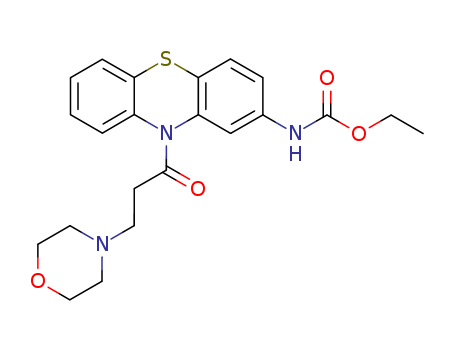
CARBAMIC ACID, [10-[3-(4-MORPHOLINYL)-1-OXOPROPYL]-10H-PHENOTHIAZIN-2-YL]-, ETHYL ESTER
- CAS:31883-05-3
- purity:99%
Buy cost-effective 99% pure CARBAMIC ACID, [10-[3-(4-MORPHOLINYL)-1-OXOPROPYL]-10H-PHENOTHIAZIN-2-YL]-, ETHYL ESTER 31883-05-3 now
- Molecular Formula: C22H25 N3 O4 S
- Molecular Weight: 427.524
- Vapor Pressure: 1.54E-15mmHg at 25°C
- Melting Point: 156-157°
- Boiling Point: 625oC at 760 mmHg
- PKA: 6.4(at 25℃)
- Flash Point: 331.8oC
- PSA: 96.41000
- Density: 1.315g/cm3
- LogP: 4.18250
CARBAMIC ACID, [10-[3-(4-MORPHOLINYL)-1-OXOPROPYL]-10H-PHENOTHIAZIN-2-YL]-, ETHYL ESTER(Cas 31883-05-3) Usage
|
Therapeutic Function |
Antiarrhythmic |
|
Side effects |
The principal adverse gastrointestinal effect of moricizine is nausea (7%). Abdominal discomfort has also been reported. Dizziness (11%) is the most frequently reported CNS-related adverse effect. Such reactions increase in frequency with prolonged drug administration. As with other antiarrhythmic drugs, moricizine has proarrhythmic activity, which may manifest as new ventricular ectopic beats or a worsening of preexisting ventricular arrhythmias. These effects are most common in patients with depressed left ventricular function and a history of congestive heart failure. Cardiovascular effects requiring drug withdrawal include conduction defects, sinus pauses, junctional rhythm, and A-V block. |
|
Drug interactions |
Clinically significant interactions with moricizine do not appear to exist. |
|
Precautions |
Patients with preexisting second- or third-degree A-V block, cardiogenic shock, or drug hypersensitivity should not be treated with moricizine. |
|
Definition |
ChEBI: A phenothiazine substituted on the nitrogen by a 3-(morpholin-4-yl)propanoyl group, and at position 2 by an (ethoxycarbonyl)amino group. |
|
Brand name |
Ethmozine (Roberts Pharmaceutical). |
|
General Description |
Moricizine, ethyl 10-(3-morpholinopropionyl)phenothiazine-2-carbamate (Ethmozine), is aphenothiazine derivative used for the treatment of malignantventricular arrhythmias. It is categorized as a class ICantiarrhythmic agent, blocking the Na+ channel with 1:1stochiometry. The drug has higher affinity for the inactivatedstate than the activated or resting states. It appearsto bind to a site on the external side of the Na channelmembrane. It has been used to suppress life-threateningventricular arrhythmias. |
InChI:InChI=1/C22H25N3O4S/c1-2-29-22(27)23-16-7-8-20-18(15-16)25(17-5-3-4-6-19(17)30-20)21(26)9-10-24-11-13-28-14-12-24/h3-8,15H,2,9-14H2,1H3,(H,23,27)
31883-05-3 Process route

-
-
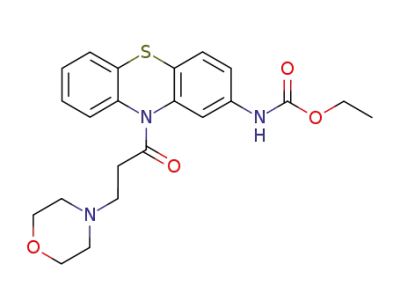
31883-05-3
moricizine
| Conditions | Yield |
|---|---|
|
Ethyl-10-(β-chlorpropionyl)-phenothiazin-2-carbamat, Morpholin;
|
|
|
Morpholin, Ethyl 10-(β-chlorpropionyl)-phenthiazin-2-carbamat;
|
|
|
10-(β-Chlorpropionyl)-phenothiazin-2-carbamidsaeureethylester, Morpholin, Toluol, Δ(2h);
|
Related products
-
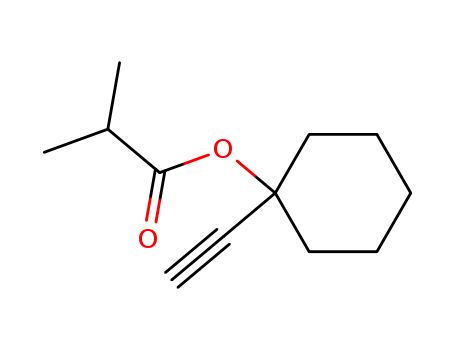
1-ethynylcyclohexyl isobutyrateDetail
CAS:72230-92-3
-
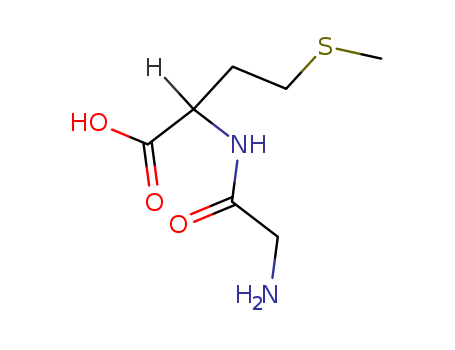
GLYCYL-DL-METHIONINEDetail
CAS:1999-34-4
-
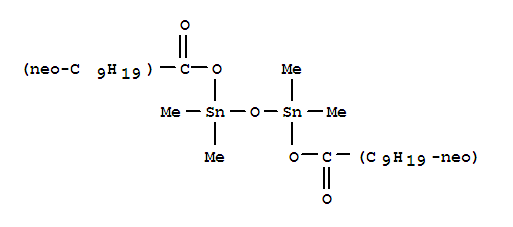
1,1,3,3-tetramethyl-1,3-bis[(1-oxoneodecyl)oxy]distannoxaneDetail
CAS:85702-77-8
-
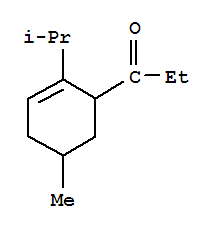
1-[5-methyl-2-(1-methylethyl)-2-cyclohexen-1-yl]propan-1-oneDetail
CAS:84559-96-6